
Ion Orins
Software Engineering | Deep Learning | MSc Computer Science @ Oxford
Projects

CatNet
2023CatNet is a deep learning architecture able to capture output inversion under input swapping and an application to the foreign exchange trading. It can learn functions Ω with the following property: Ω(a, b) · Ω(b, a) = e, where a, b ∈ S, Ω : S × S → G, and e is the identity element of the group G, as long as there is an isomorphism F from G to an additive group G+. We prove its correctness and universality, suggest a particular implementation of this architecture, and test it on a synthetic dataset. Lastly, we justify the usefulness of this architecture and test it on a real-world task, namely currency trading on the foreign exchange market.

Multimodal and Multitask Learning on Segmentation Data
2023This study aims to provide a framework for integrating as much available data in a single architecture on a semantic segmentation task, with the aim to increase performance and decrease resource consumption. On the input side, we use multimodal learning to combine the different available inputs, i.e. the MRI scans and the demographic data of the patients, with the motivation that using more data will yield better results. On the output side, we employ multitask learning to jointly learn brain extraction and subcortical structure segmentation, in the hope that having common representations for the two tasks will result in inductive transfer and decreased use of computational resources.

Cora Visualiser
2023Graph representation learning is a popular field that applies machine learning techniques to network data. Graph Neural Networks (GNN) are widely used and the Cora dataset is a standard benchmark for these models. However, the dataset is often used as a black box in deep learning frameworks, limiting researchers’ ability to debug and gain deeper insights into their GNN models. This project aims to visualize the interaction between the Cora dataset and Graph Convolutional Networks (GCNs), a popular GNN architecture. Users can explore the dataset by visualizing the citation network as a graph and interact with the nodes to learn more about the papers. Additionally, the GCN’s interpretation of the network can be observed by linking node coordinates in the visualization to the model’s internal representations using dimensionality reduction. Users can track the evolution of these internal representations during training and adjust GCN properties using a dropdown menu.

Stable Confusion
2023A tool build using GPT that aims to help lawyers find inconsistencies in contracts.

Continual GNNs
2022Does the attention mechanism help ameliorate catastrophic forgetting in graph neural networks? Catastrophic forgetting describes the phenomenon in which neural networks have a tendency to perform worse on previously learned tasks when trained sequentially on new tasks. This is because weights important for earlier tasks are overwritten when training on new tasks. Relevant literature suggests that attention does indeed have a positive impact on knowledge retention. This project proposes and utilises a more robust experimental set up to prove these previous findings.

Dynamic Learning for Recommender Systems
2022This dissertation aims to tackle the inefficiencies of Graph Neural Network-based recommender systems by employing continual learning techniques. Recommender systems are extensively used in the technology sector with great success, with the goal of better tailoring the provided services to the individual customer’s needs. An emerging recommender system paradigm based on Graph Neural Networks is becoming increasingly popular, yielding state-of-the-art results. However, it is difficult to use these algorithms in production as they need to be continuously updated to the heaps of new data that is being generated in real time and, when naïve “update” methods are used, neural network based solutions are well known to suffer of catastrophic forgetting (the tendency to perform worse on patterns in old data when the model is exclusively trained on new data). This project explores various approaches to ameliorate this issue and quantifies the trade-offs between the alternative solutions. There is a focus on testing replay- and regularisation-based methods, which are compared against naïve baseline methods. It is concluded that replay-based methods yield significant improvements both in terms of efficiency and accuracy.

BallotBox
2021The aim of the project was to produce a prototype system that allows the participants of an event to provide live feedback to the host. Moreover, it will give an estimate of the overall “mood” of the whole group during the event or some particular sessions. It tracks the users’ emotions using a combination of classical statistical and deep learning methods.

Detect Green
2019A program that detects crops and weeds from drone images. It uses a combination of deep learning and classical computer vision techniques to be able to distinguish desirable crops and pests from aerial photos at a very high frame rate.
Media Mentions

Forbes 30 Under 30 Romania
2022I was chosen in 2022 to receive the prestigious Forbes 30 under 30 award by Forbes Romania for my contributions as a software developer to the fintech and blockchain company Modex.

Blogpost about My Career at Modex
2020I worked at Modex for almost 5 years, where I was hired just a week after I turned 18. This blogpost talks about my journey as the youngest employee of the company.

Liminal Terraforming Hackathon
2017The theme of the hackathon was technology that could help terraform an extraterestrial planet. Our project consisted of a telescope and a microscope enhanced with object recognition. Our performance was featured in Vice.com.
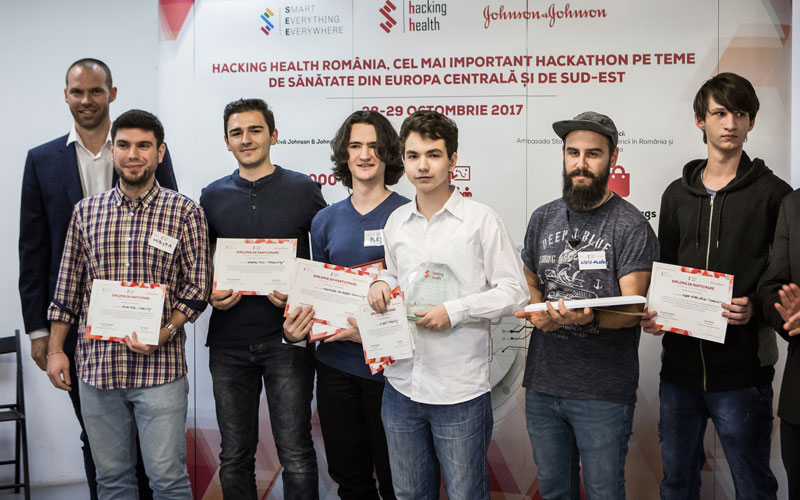
Hacking Health Hackathon
2017I participated in this hackathon organised by Jensen&Jensen. My team built an app to facilitate an efficient management of the blood donors. The idea started inside the team from high number of emergencies related to the lack of blood donors. With the help of this application, donor centers would be able to optimize donor databases and their flow. Though the notifications sent by the application, donors would be able to present themselves to the centers within a timeframe that is appropriate to their availability. Our performance was featured in the renowned Romanian Journal “Știință și Tehnică” (Science & Technology).